Everything in this course is built out of one line, so this is the lesson to take slowly.
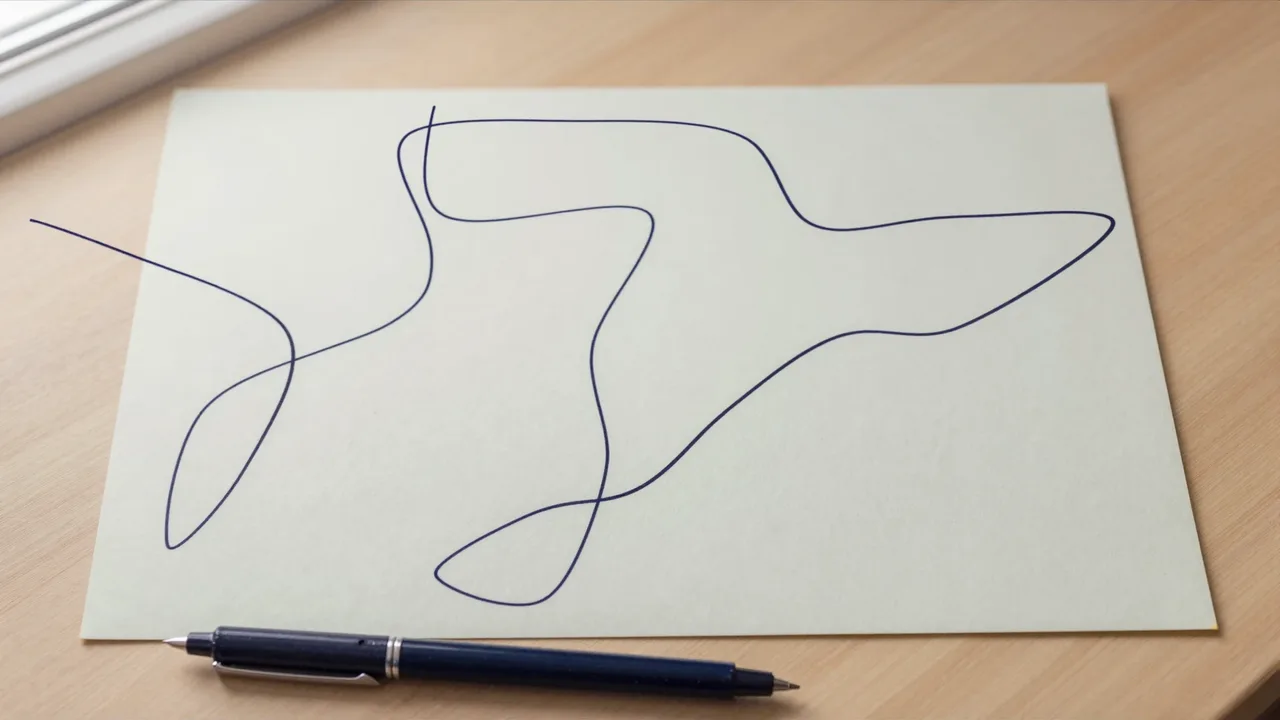
The line runs without stopping. It curves, doubles back on itself, crosses its own path, and it does not repeat: no stretch of it looks quite like the stretch before. That last part is the whole difficulty, and it is not a difficulty of skill.
Drawing it
Put the marker down anywhere on the sheet and start moving. Do not pick a destination — the line is not on its way somewhere.
Keep it going. Lifting the marker to look at what you have done is how the line turns into a drawing you are managing. Let it run for a while before you stop.
Keep changing. Change the size of the curves, change how tightly they turn, change direction. A stretch of small tight loops, then a long slow bend, then a sharp turn back across the page.
Go where the hand does not want to go. This is the one instruction in the lesson that will feel wrong. When you can feel that the marker is about to swing the familiar way — the way it has already gone three times — take it the other way instead. Your hand has habits. Left alone it will draw the same handful of curves for the rest of the sheet.
You will feel resistance doing this, and that is expected rather than a sign you are doing it badly. Drawing an unfamiliar line is uncomfortable in the way that writing with the wrong hand is uncomfortable. It passes.
The four lines below
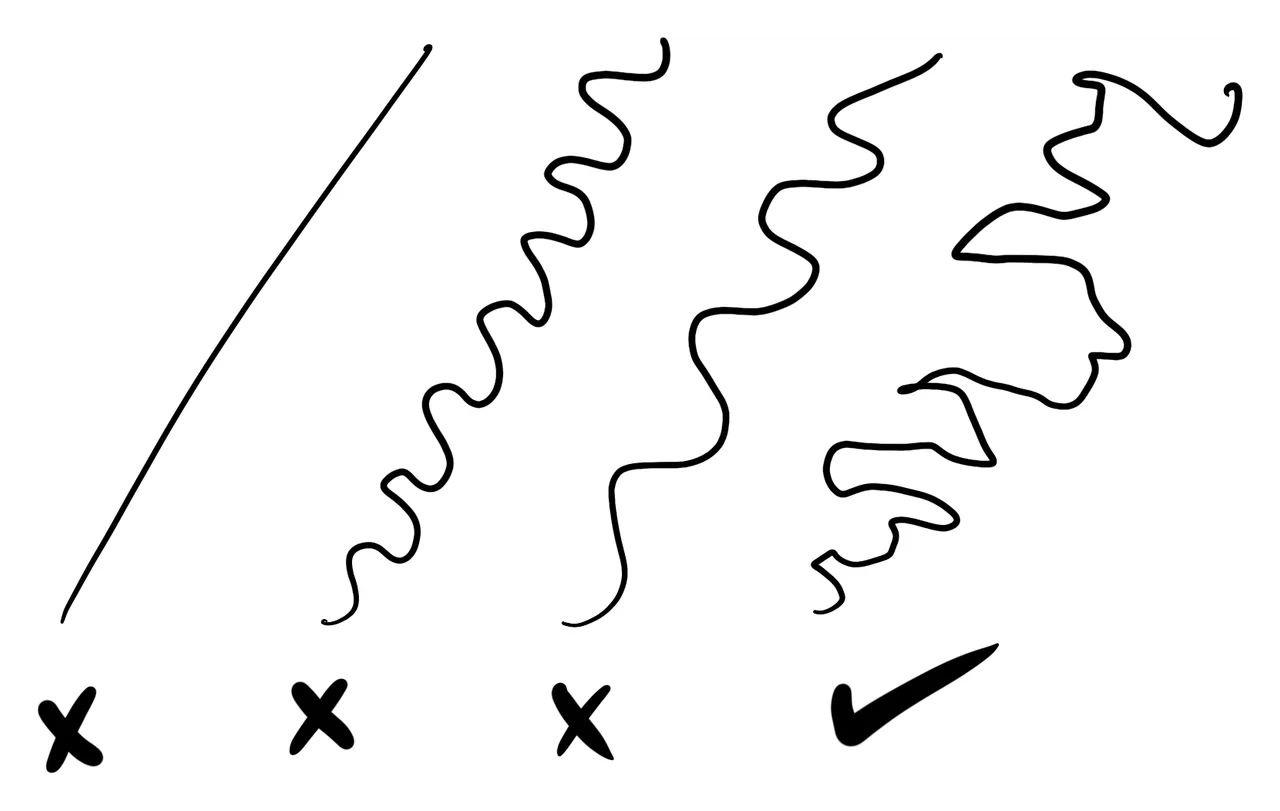
The picture at the end of this lesson shows four attempts. Three are marked with a cross and one with a tick, and the reason is the same in each case.
The straight line. Nothing changes anywhere along it. There is one decision in it, made at the start.
The line of even loops. It changes constantly, but in a pattern — loop, loop, loop, all the same size. A repeating pattern is a single decision too; it just takes longer to draw.
The regular wave. Larger and smoother, and still the same shape over and over.
The fourth one. Turns of different sizes. Stretches that tighten and then open out. A couple of places where it goes somewhere you would not have predicted from the inch before it. That is the line.
What to look at in your own
Not a scoring system — five things worth noticing when you look back at a sheet.
It flows. No hard stops and starts, no places where the marker was clearly parked while you decided.
It varies. Loops, spirals, long bends, tight corners, all in the same line.
It surprises. Somewhere in it there is a turn you did not plan.
It sits well on the page. Not symmetry — just that the sheet does not feel lopsided, with everything crowded into one corner.
It is yours. Two people following this lesson exactly will produce lines that look nothing alike, and neither of them is doing it wrong.
Your practice
Ten minutes, one sheet, marker down.
Fill the page with line. You can do it as one continuous line that wanders everywhere, or as several long ones — but each of them should run for a good while before you stop it. Aim to cover the sheet rather than to make something that looks good.
Do not throw away the attempts you dislike. Photograph the sheet as it is and put it in your journal.
In the note, answer two things: where did your hand go the familiar way, and what was different about the end of the sheet compared with the beginning.
That sheet is also the raw material for module 2 — the crossings you have just made are what the next lessons are about, so keep it.