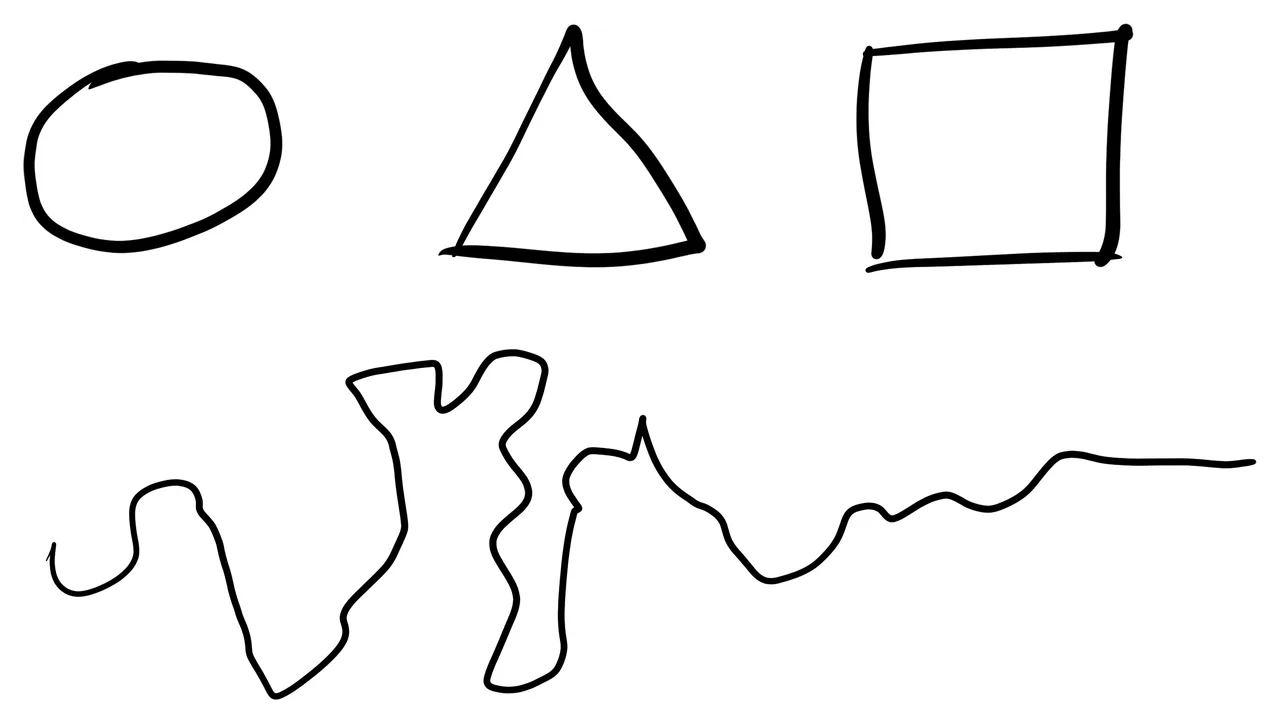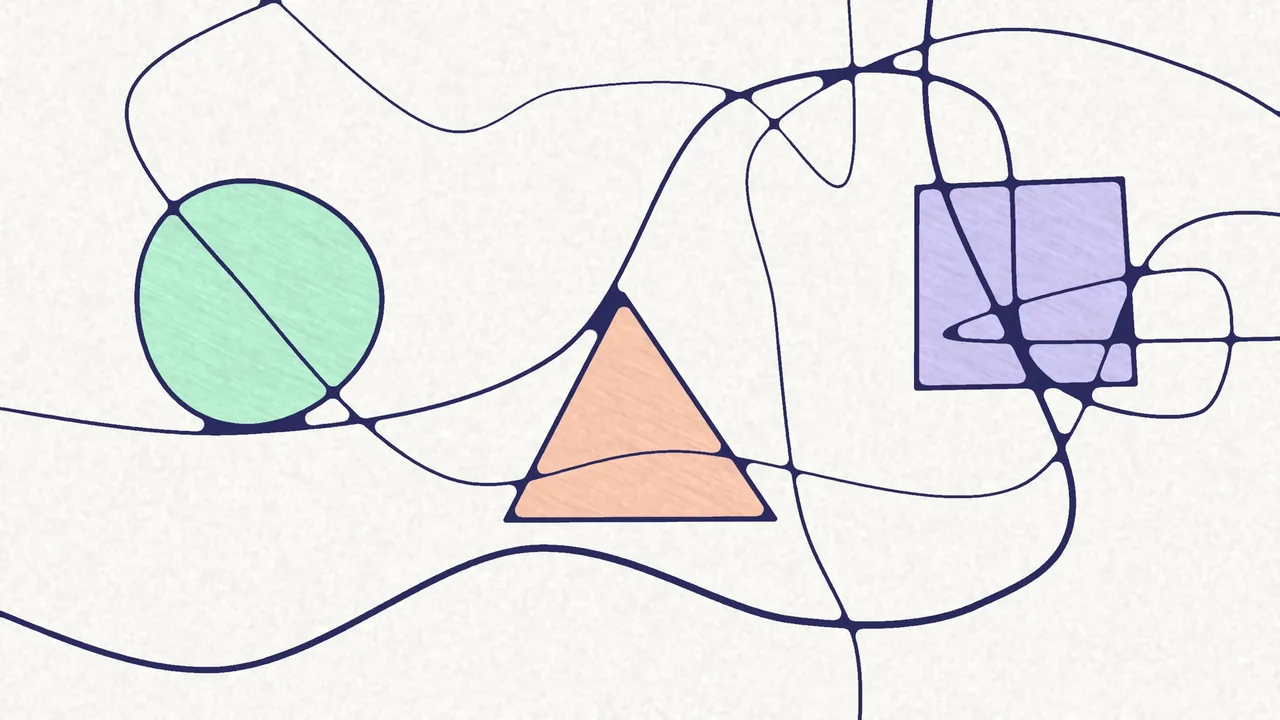
The line from the last lesson is one half of the alphabet. Shapes are the other half, and there are only three of them worth learning: a circle, a triangle, a square. You can see all three at the end of this lesson, drawn the way they are meant to be drawn — quickly, by hand, slightly uneven.
Do not reach for a ruler or redraw a circle that came out lopsided. A shape here is a mark you made, not a diagram.
What they are usually taken to mean
Read this as a starting point. The meanings below are the common ones, and the next section is the more important half of the lesson.
The circle. Wholeness, a thing complete in itself. Cycles, something that comes back around. Often used for a person, a relationship, a situation held together.
The triangle. Movement and change. Direction, because it points. Effort and tension too — three straight sides meeting at corners is not a restful shape.
The square. Structure and ground. Rules, walls, frames. What holds, and equally what confines — the same four sides read either way depending on what you put inside them.
The line. Connection and movement between things. A curving line moves loosely; a straight one goes directly from one place to another. When a line joins two shapes, the kind of line is saying something about the join.
The meanings you assign are the ones that count
A square is not obliged to mean structure because a list says so. If squares remind you of the block of flats you grew up in, then in your drawing that is what a square is, and the list is wrong and you are right.
This is not a gentle disclaimer, it is how the practice works. You are making marks and deciding what they stand for; the deciding is the part that does anything. Two people can draw the identical three shapes and be drawing about completely different things.
Which is also why nobody can interpret your drawing for you.
Your practice
One sheet. Pick something to think about before you start — a question, a decision, a situation. Keep it in your head; nothing gets written on the paper.
Draw three to five shapes. Do not plan the layout: put each one down where your hand goes, different sizes, anywhere on the sheet, overlapping is fine.
Now connect them with lines, the way you learned to draw a line in the last lesson — wandering, changing, not the shortest route between two shapes. Let the lines run past the shapes and across each other. You want crossings; the next lessons are made of them.
Photograph the sheet and put it in your journal.
In the note, write down what each shape stands for. Not what the list above says — what it stands for for you, today, in this drawing.
Keep the sheet. You will be rounding it.