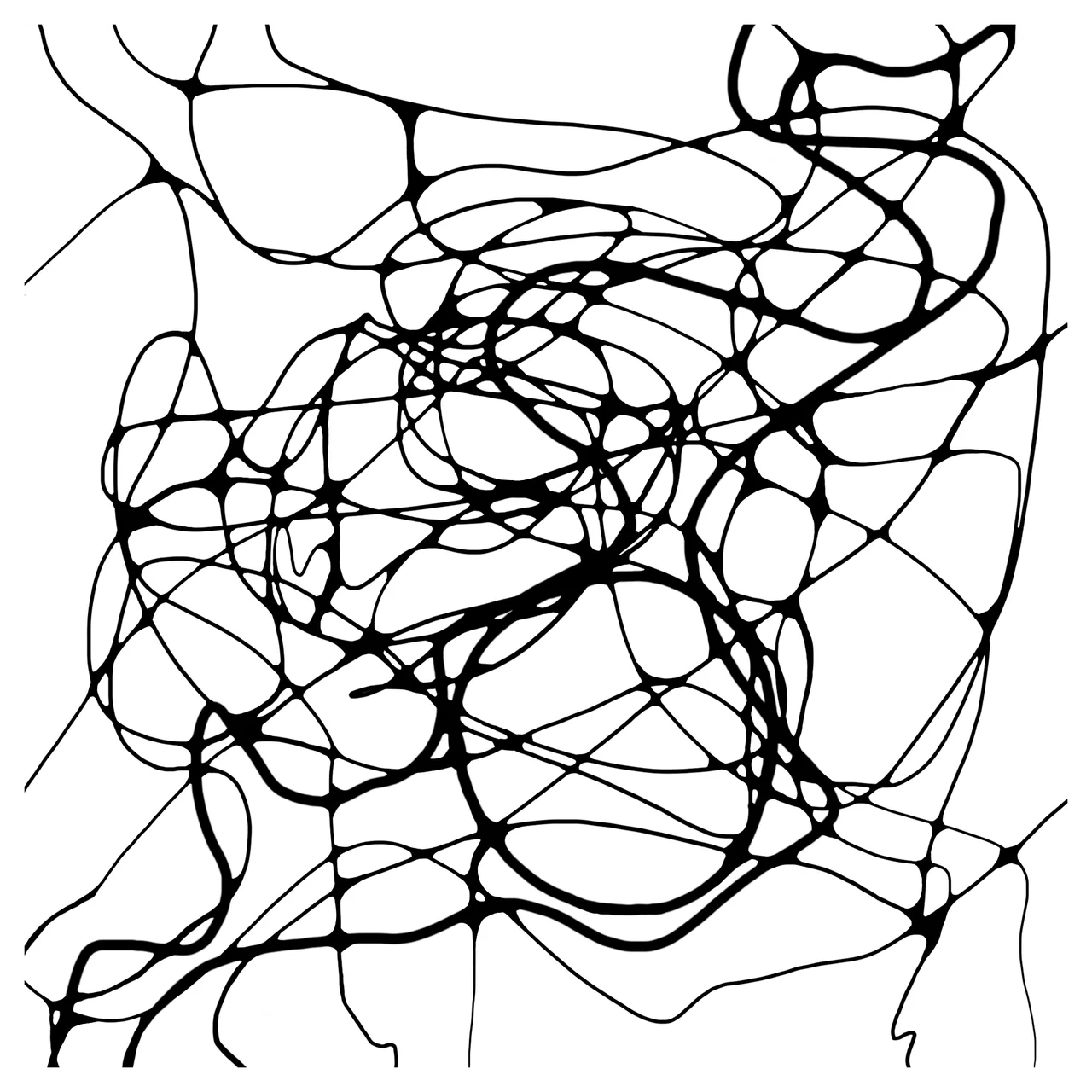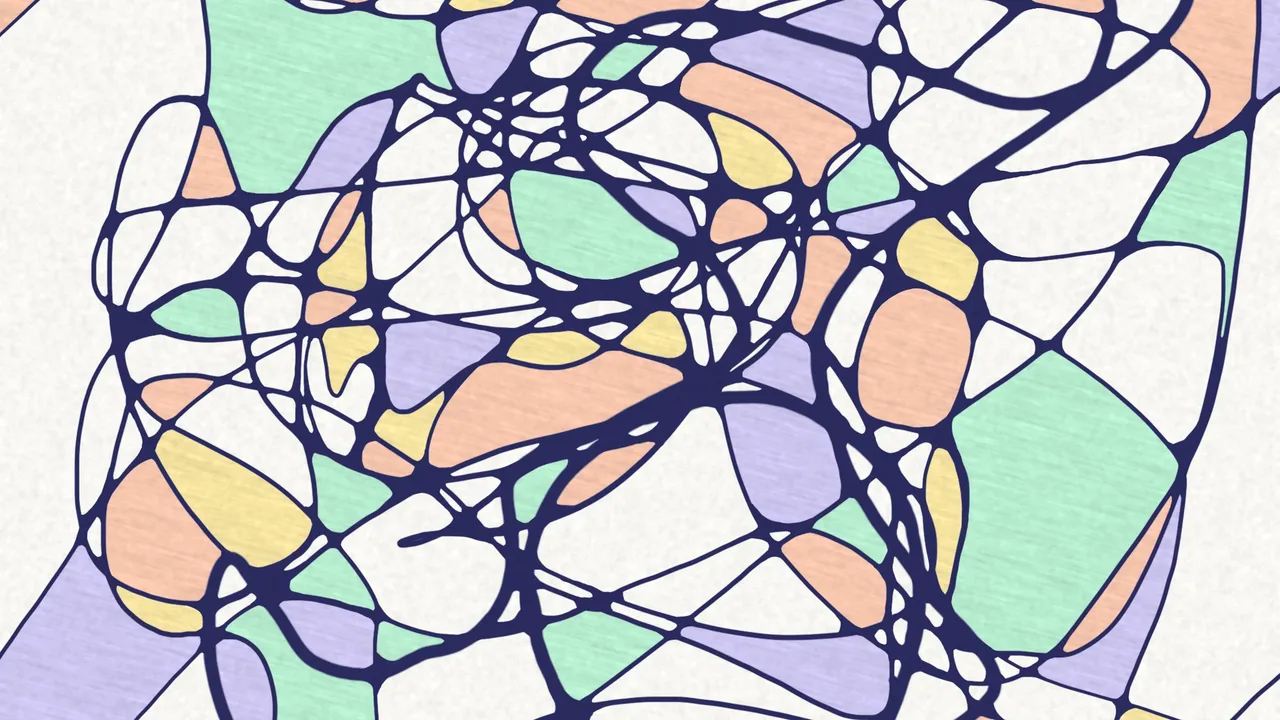
This is a drawing practice. You take a sheet of paper and a marker, draw a line that wanders across it, add a few simple shapes, and then go back over every place where two lines cross and round the sharp corner away. That is the whole technique. The drawing at the end of this lesson is what it looks like when it is finished.
You do not need to be able to draw. Nothing here is judged on how it looks, and there is no result you are supposed to arrive at. The work is in the doing.
What actually happens on the page
A session has the same shape every time, whether it takes you twenty minutes or an hour.
You pick something to think about. A question, a decision, a mood — or nothing at all, which is a perfectly good place to start. The subject stays in your head; it is not written on the paper.
You start moving the marker. The first line goes down without a plan. It curves, doubles back, crosses itself. You keep it going instead of lifting the marker and thinking.
Shapes join it. Circles, triangles, squares — drawn quickly, placed wherever they land, connected by more lines.
You round every crossing. Two lines meeting make four sharp corners; you soften each one into a smooth joint. This is the slow part, and it is the part the whole practice is built around.
You look at what you made. Sometimes that is all. Sometimes you notice something about the thing you sat down with.
Colour is optional and comes last, if at all.
Why the rounding matters
It is worth saying early, because the first time through it feels like tidying up. It is not tidying up — it is most of the time you will spend, and the rest of the drawing exists to give you crossings to work on.
Rounding is also the part you can see change under your hand. A spiky tangle becomes a set of smooth, connected forms, and you are the one who did it, corner by corner. Module 2 is entirely about this step.
What the meanings are worth
Later lessons say what circles, triangles and colours are commonly taken to mean. Read those as a starting point and nothing more. A square is not obligatorily "structure" because a book says so — if it means a room you used to live in, that is what it means in your drawing. The associations you bring are the ones that count, and they are the reason two people can draw the same shapes and get nothing alike.
What this course is
Nine lessons in three parts. You will draw in almost every one, and each drawing goes into your journal with a note about how it went — that is what turns nine readings into nine practices you can look back at.
Next: what to buy, which takes about five minutes and one trip to a stationery shop.