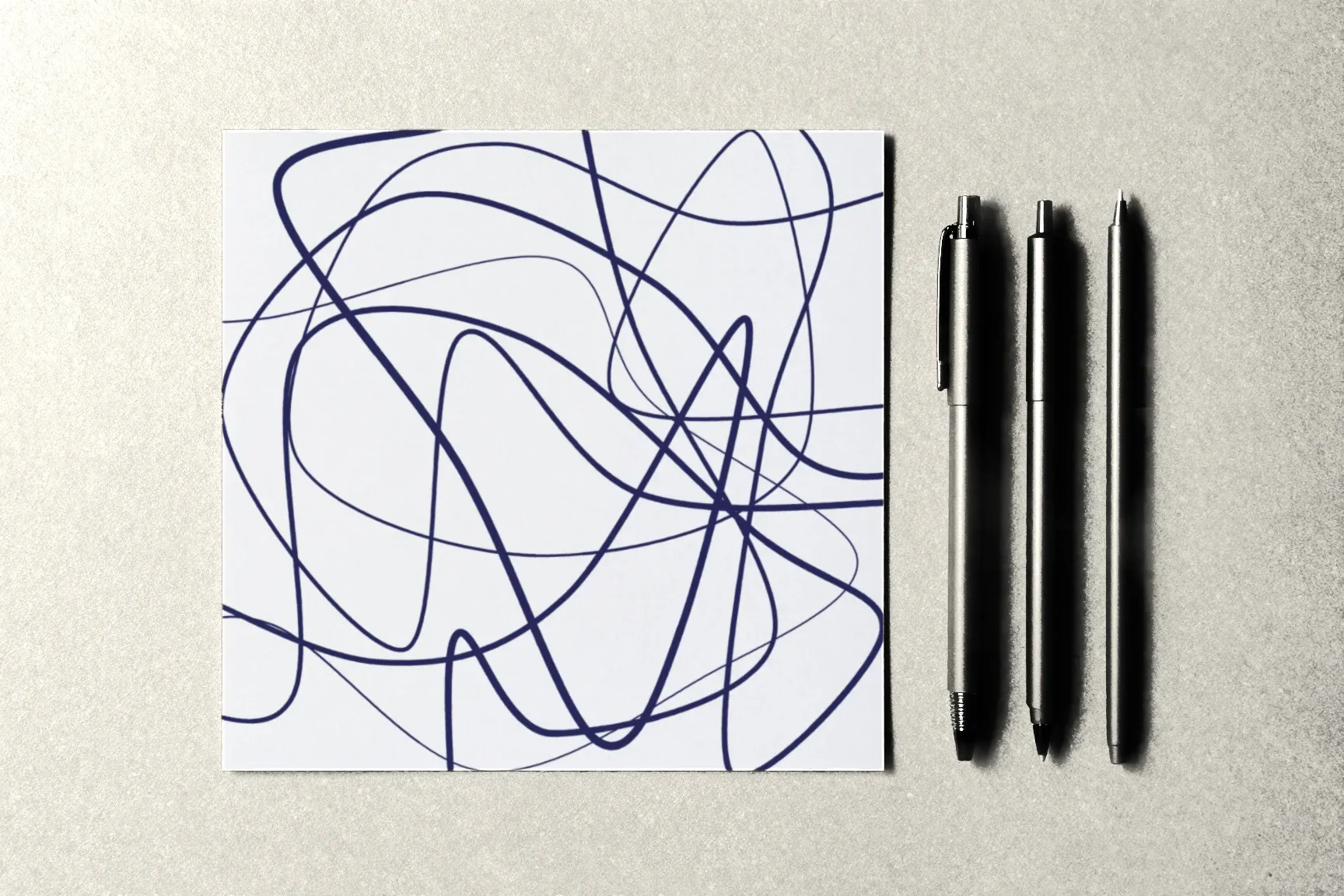
The black line is the backbone of a transformational drawing, and the pen you draw it with affects everything: the character of the line, how fast rounding goes, and whether the outline smears under color. You don’t need an expensive set, but it helps to understand how the types of pens differ.
Here are five kinds of black pens, how each behaves at the technique’s three steps, and which pair to choose.
Fineliner
A pen with a thin fiber tip and a precise line width — usually from 0.05 to 0.8 mm, sometimes more.
- Lines: even, crisp, the same width throughout. 0.3–0.5 mm is the most comfortable for a free line on a letter-size sheet.
- Rounding: slow with a fine tip — you have to fill each corner with many strokes. A 0.8 mm or thicker pen works better for rounding.
- Under color: a fineliner with pigment ink won’t smear under markers once it’s dry. That’s its biggest advantage.
Downside: pressing hard flattens the tip, and the line gets wider. Hold it lightly.
Gel pen
- Lines: rich and smooth; the pen glides easily on smooth paper.
- Rounding: gel ink fills corners nicely but dries slowly — easy to catch with your hand.
- Under color: it can smear if a marker crosses a line that isn’t fully dry. Give the lines a few minutes.
Downside: it can skip on textured paper.
Ballpoint pen
- Lines: paler, and they need pressure. Fine for a first page.
- Rounding: slow and uneven; you have to hatch each corner many times. Little blobs of ink can collect here and there.
- Under color: usually doesn’t smear, but a pale line gets lost next to bright color.
Bottom line: good enough to try the technique, but for regular practice a fineliner is the better choice.
Brush pen
A pen with a flexible brush tip: the line width depends on pressure.
- Lines: thin to wide within a single stroke. The line looks alive, with varying weight.
- Rounding: the fastest option of all — a big corner fills in one or two strokes.
- Under color: depends on the ink. Pigment brush pens hold up; water-based ones can bleed under water-based markers.
Downside: takes some getting used to; controlling the width is tricky at first.
Permanent marker
- Lines: thick and very dark.
- Rounding: quick, but small crossings flood easily.
- Under color: doesn’t smear.
Downside: alcohol-based ink bleeds through even heavy paper and has a strong smell. Good for general lines and big circles, not for a whole drawing.
Which pair to choose
It’s easiest to work with two pens:
- For lines — a pigment fineliner, 0.3 or 0.5 mm.
- For rounding — a 0.8 mm fineliner or a brush pen.
What matters most is that both give the same black. Different brands make different blacks — some lean blue, some brown. Test on scrap paper so the rounded spots don’t stand out by color.
How to test a pen at home
- Draw a long wavy line — does the ink flow evenly around the curves?
- Fill a small corner — does it go down solidly?
- Wait a minute and run a finger across the line — does it smudge?
- Go over the line with the marker you’ll color with — does it stay crisp?
If a pen passes all four, it’s a keeper.
What comes next
For paper and coloring markers, see What You Need to Start Drawing; for playing with line thickness, see Thick and Thin. The Neurojournal course has a lesson on tools in “The alphabet” module. The first module is open without an account — start there.