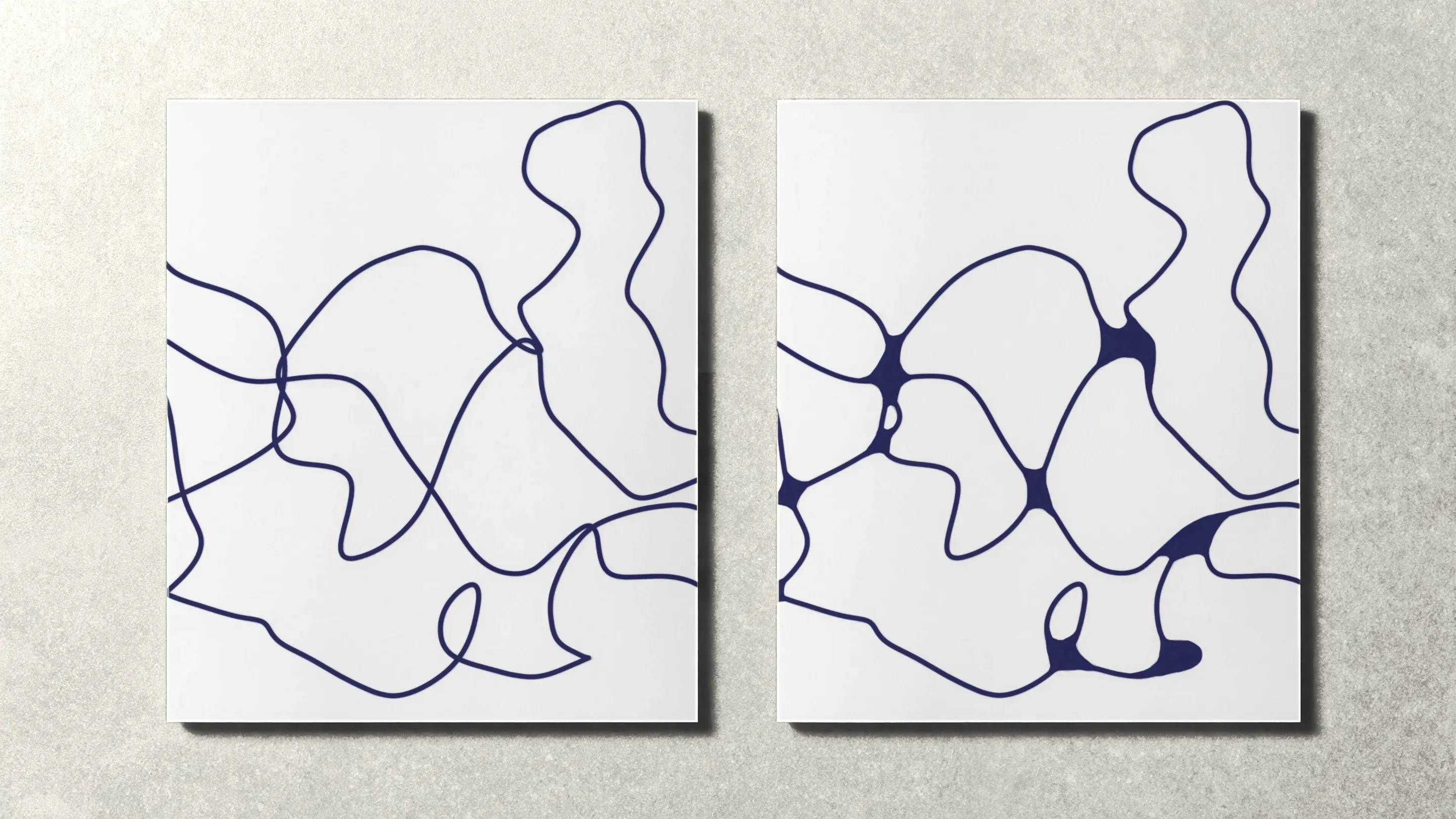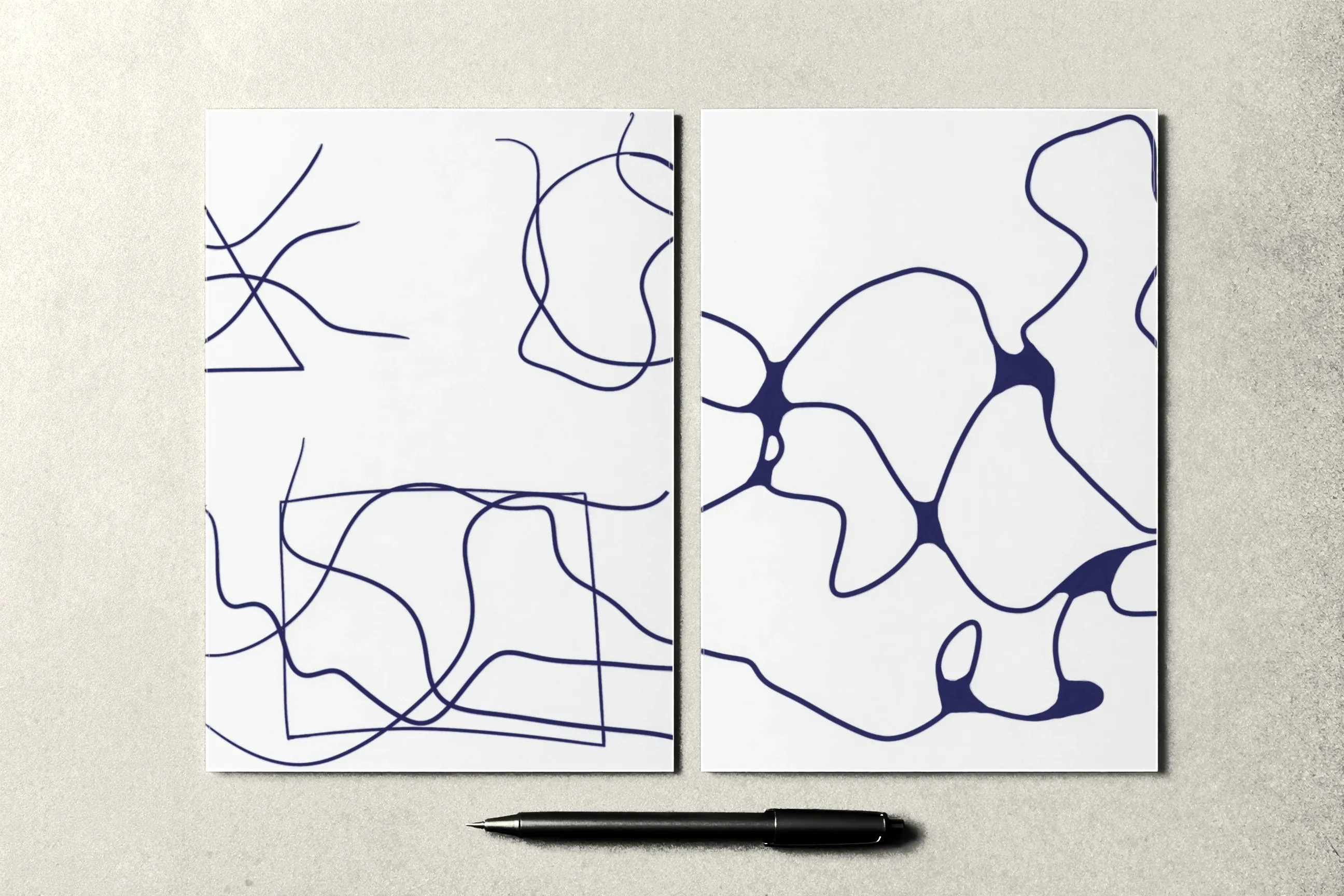
Neurojournal is a self-guided course in transformational drawing. You read a lesson, draw on paper, and — if you like — save the drawing in your practice journal. There’s no schedule, no group, and no instructor waiting for homework: the course moves at your pace, one lesson at a time.
Here’s what the course is made of, what’s in each module, what a lesson looks like, and what you can open without a subscription.
Three modules, twelve lessons
The course has three modules. Each builds on the one before it, so it’s easiest to take them in order.
Getting started
Two introductory lessons: what the technique is and how it works. They cover the core ideas and the order of a session — preparing your space, settling in, letting your hand move freely, and looking at the drawing afterward. This module is open to everyone, no account needed.
The alphabet
Five lessons, one for each element of the technique:
- the line — what it should be like, how it differs from an ordinary wave, with examples of what works and what doesn’t;
- rounding — how to soften the corners where lines cross, step by step, with practice templates;
- shapes — the circle, the triangle, the square: how to place them in a drawing and connect them to the lines;
- colors — how to color a drawing and what colors can mean to you;
- tools — paper, pens, markers, setting the mood, and a playlist for your sessions.
After “The alphabet,” you know every step of the technique and can draw on your own.
Algorithms
A themed algorithm is a sequence of steps where every action has its place: lines, rounding, a circle, long lines across the whole sheet. The module opens with a lesson on what an algorithm is, followed by three algorithms of nine to ten steps each. Each step on the page is shown as its own frame of the same drawing, so you can see the sheet change from step to step. The course closes with a short note to readers.
What a lesson looks like
A lesson is a page in your browser, on your phone or computer. There’s nothing to install.
- Text explains the step and the order of work.
- Diagrams and frames show what it looks like on paper — in the algorithms, one frame per step.
- Printable sheets. Practice templates download as A4 PDFs that print fine on Letter paper too: the lines are already drawn, and you round the corners or add shapes.
- Exercises. Most lessons in “The alphabet” end with an exercise to try on your own sheet.
A lesson has no time limit. You can read it in five minutes and draw for half an hour, or come back to it a week later.
Progress and the practice journal
When you’re signed in, each lesson has a “Done — next lesson” button. It marks the lesson complete and takes you to the next one. The course page shows how many lessons you’ve finished and where to pick up.
After a lesson you can record your practice: take a photo of the drawing and add a few words — what you drew, where you lingered, what you noticed. The entries build up into a practice journal where all your drawings sit by date. The journal is private: only you can see it. You can delete entries one by one, and download or delete all your data along with your account.
How to move through the course
There’s no fixed schedule, but a few habits help:
- One lesson, one or two drawings. After a lesson in “The alphabet,” try it on paper before moving on. The line and rounding in particular reward practice — repeat them a few times.
- Use the templates to warm up. A printed sheet with the lines already drawn lets you practice rounding on its own, without thinking about composition.
- Take the algorithms slowly. One algorithm is one complete drawing, an evening’s work. You can go through them in order or come back to the same one several times.
- Journal after every drawing. A photo and two or three sentences take a minute; after a month they add up to a record of your practice.
The course is available in English and Ukrainian. You can switch languages in the site footer, and your progress and journal stay the same.
What’s open without a subscription
- The “Getting started” module is open to everyone, no sign-up required.
- The rest of the course comes with a subscription. It starts with free days that open “The alphabet” and the first algorithm. The second and third algorithms and the closing lesson open after the free days.
Current prices and terms are on the subscription page. You can cancel any time, and you keep access until the end of the period you’ve paid for.
Who this format suits
A self-guided course works well if you like going at your own pace: drawing in the evening, on weekends, taking a week off when life gets busy. It also suits people who have never drawn before — the course begins with a single line and doesn’t require sketching skills or color theory.
What a self-guided course doesn’t have is a live instructor to look at your drawing and give you pointers. Instead, there are diagrams, step-by-step frames for the algorithms, and your own journal, where you can see your drawings change over time.
One more thing: the course teaches a drawing technique. It isn’t therapy and isn’t a substitute for care from a doctor or a licensed mental health professional.
Where to begin
Open the first lesson of “Getting started” — no account needed. If you want to try the technique on paper afterward, there’s a plan for your first session in How to Start Drawing as an Adult, and a supply list in What You Need to Start Drawing. For a closer look at the free module, read Inside the Free “Getting Started” Module.