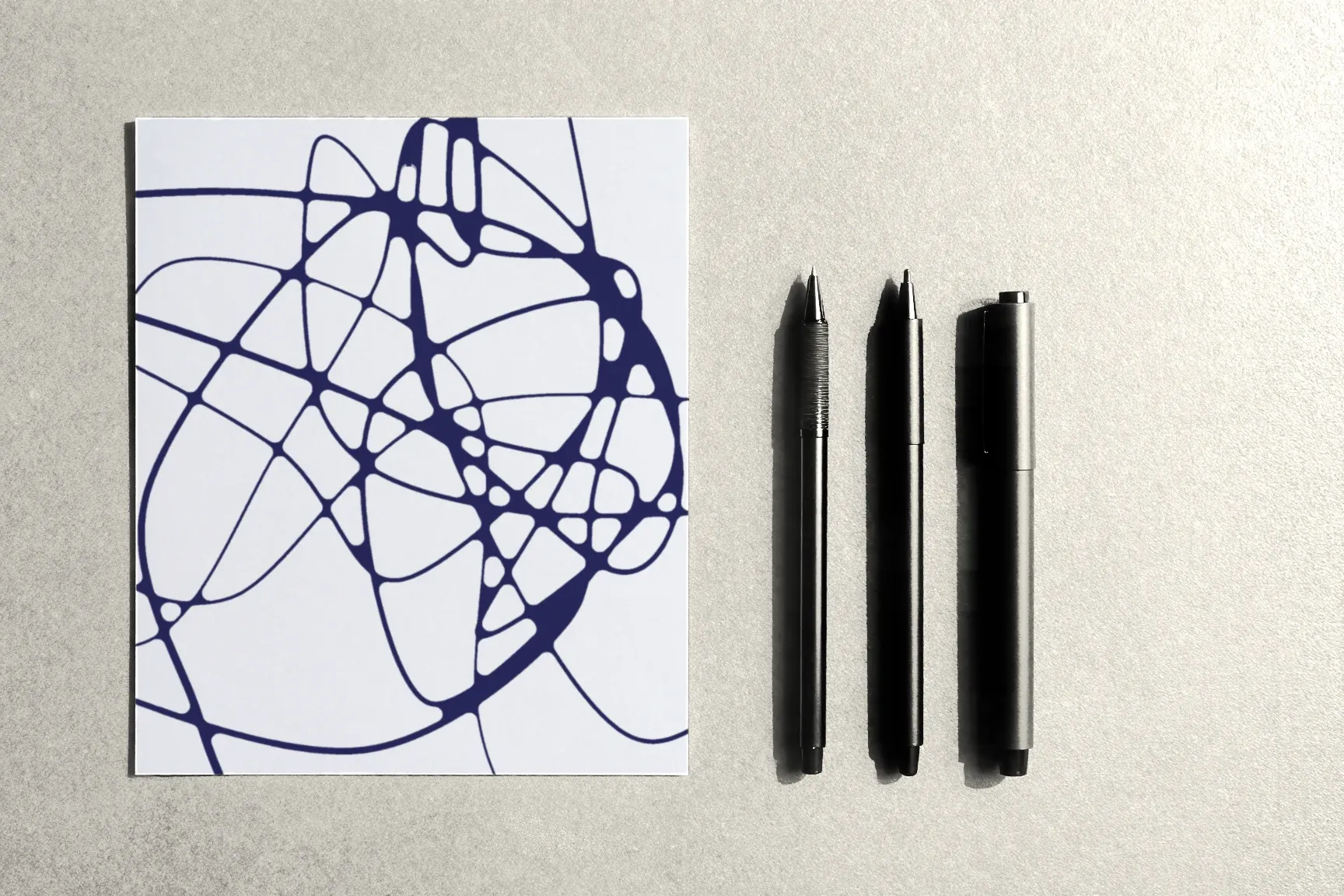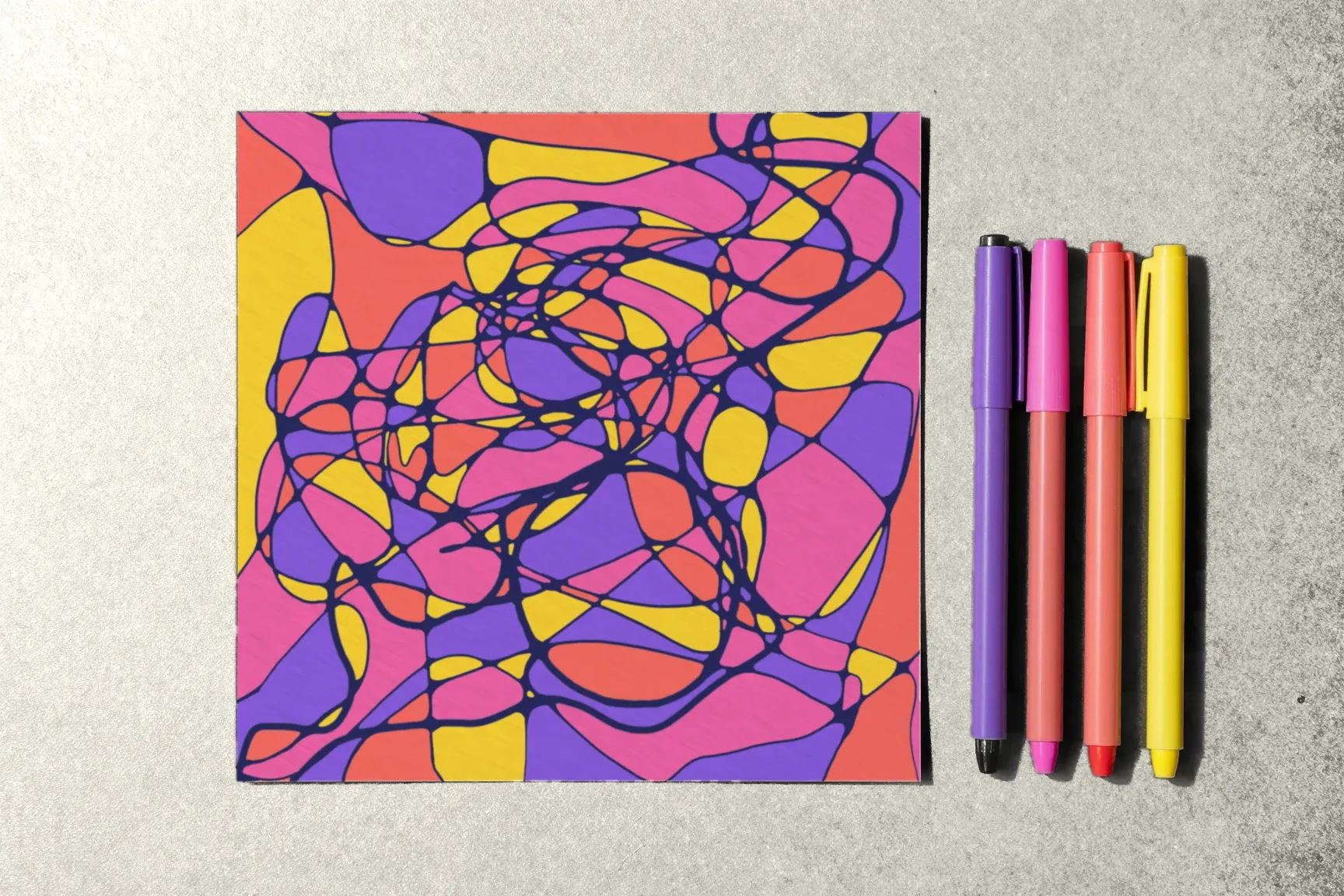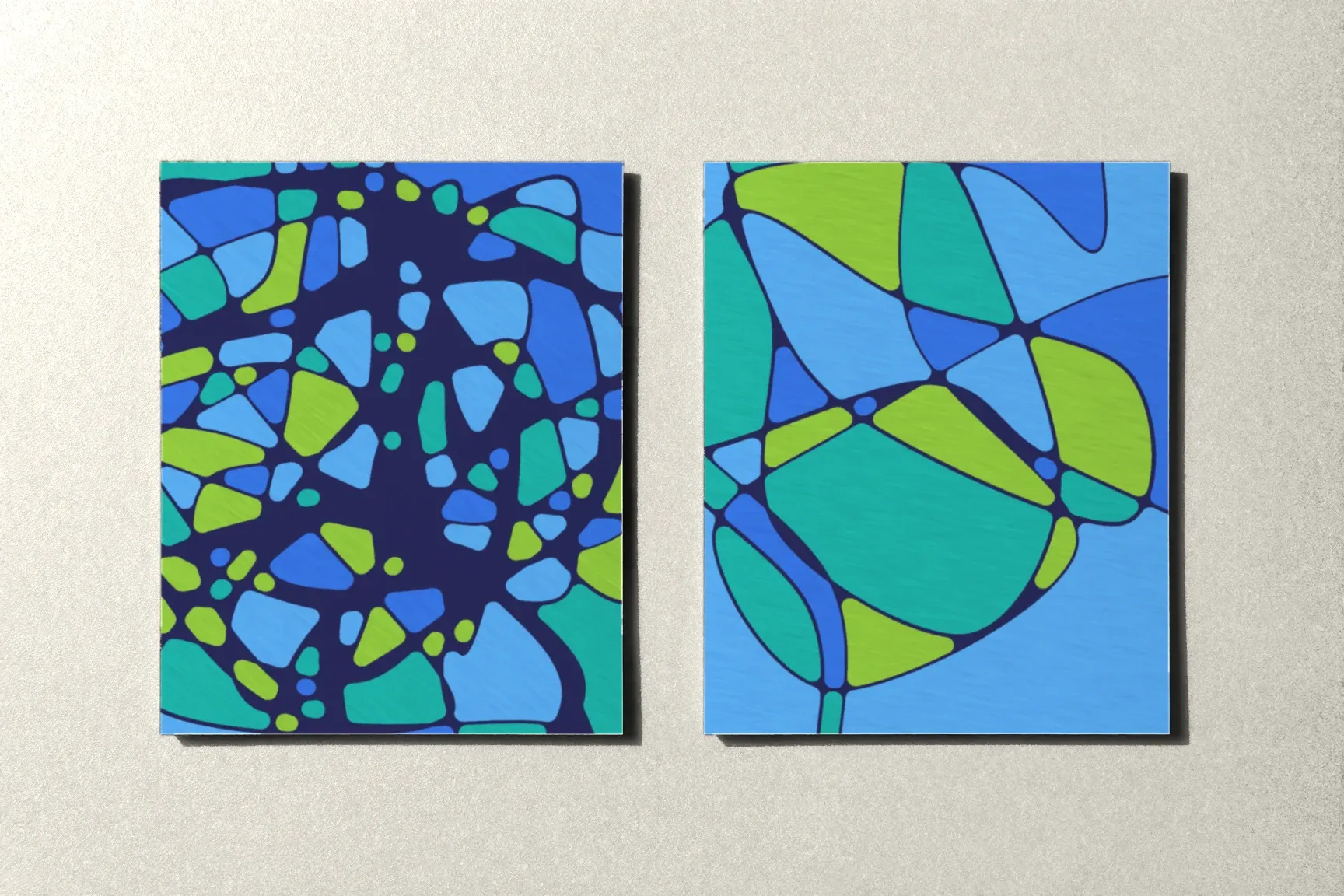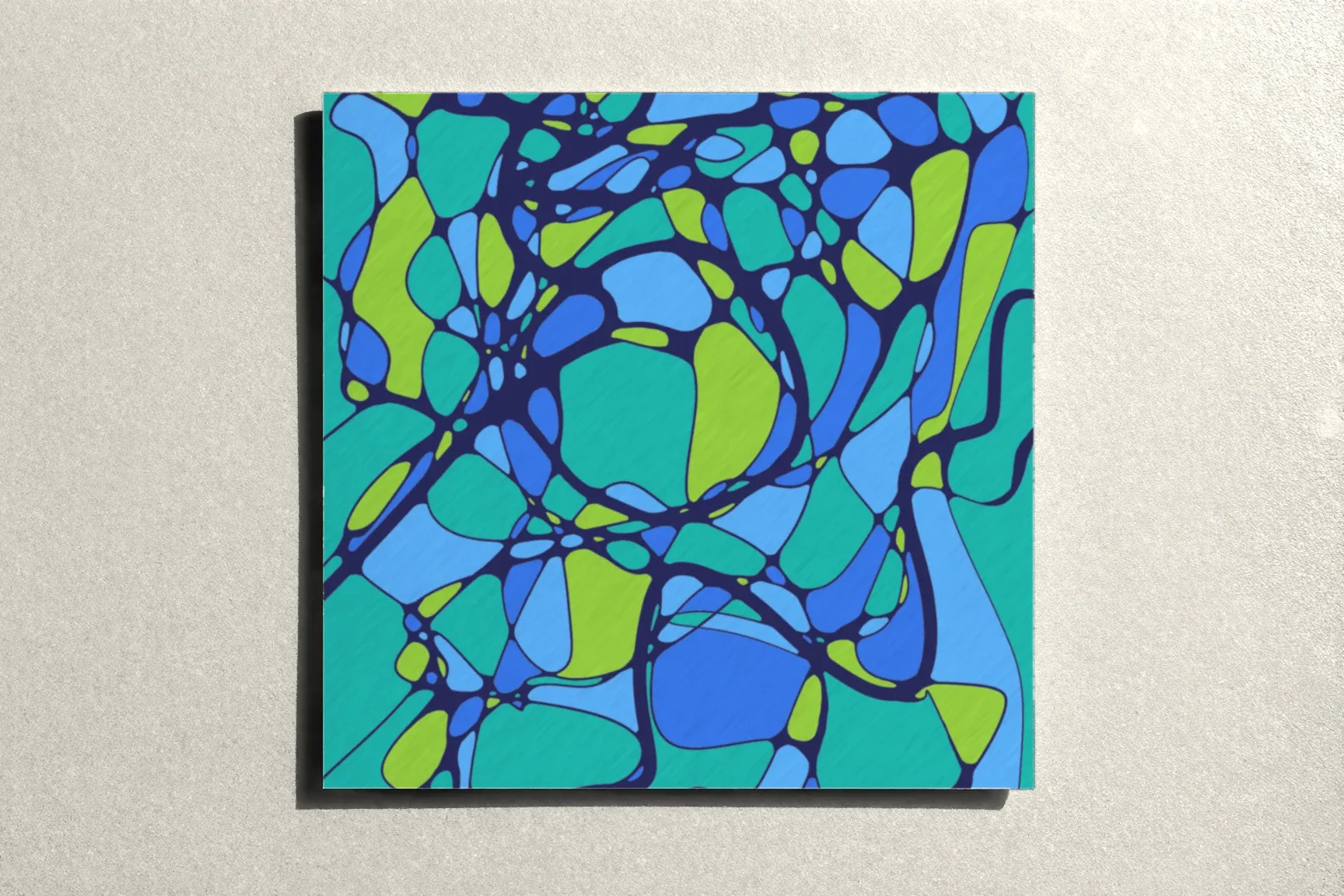
Transformational drawing has no subject and no object to place on the page. But it still has composition: how the lines are spread across the paper, where they’re dense, where they’re sparse, where there’s room to breathe. Composition decides whether a drawing looks whole or seems to have slid into one corner.
Here’s why lines run edge to edge, how to fill a page evenly, where to leave empty space, and how a shape can become the center of a drawing.
What composition means in this technique
Composition here isn’t about what is drawn but how the page is filled:
- density — how many lines and crossings there are in a given area;
- balance — whether they’re spread across the whole page or bunched in one place;
- rhythm — how long, smooth stretches alternate with small turns;
- breathing room — the large and small cells left between the lines.
All of this comes together on its own as you draw, but a few simple moves help you end up with a page that feels whole.
Why edge to edge
A line that starts and ends beyond the edge of the page makes the drawing look like a piece of a larger pattern. There’s no frame and no sense of the drawing being squeezed into the middle. The page fills evenly, because the line passes through every area instead of circling in one.
The course turns this principle into a step of its own. Its algorithms include general lines: a few lines across the whole sheet that, as the course suggests, you imagine starting and ending far beyond its edges. There are usually two or three, and they tie together everything drawn before them.
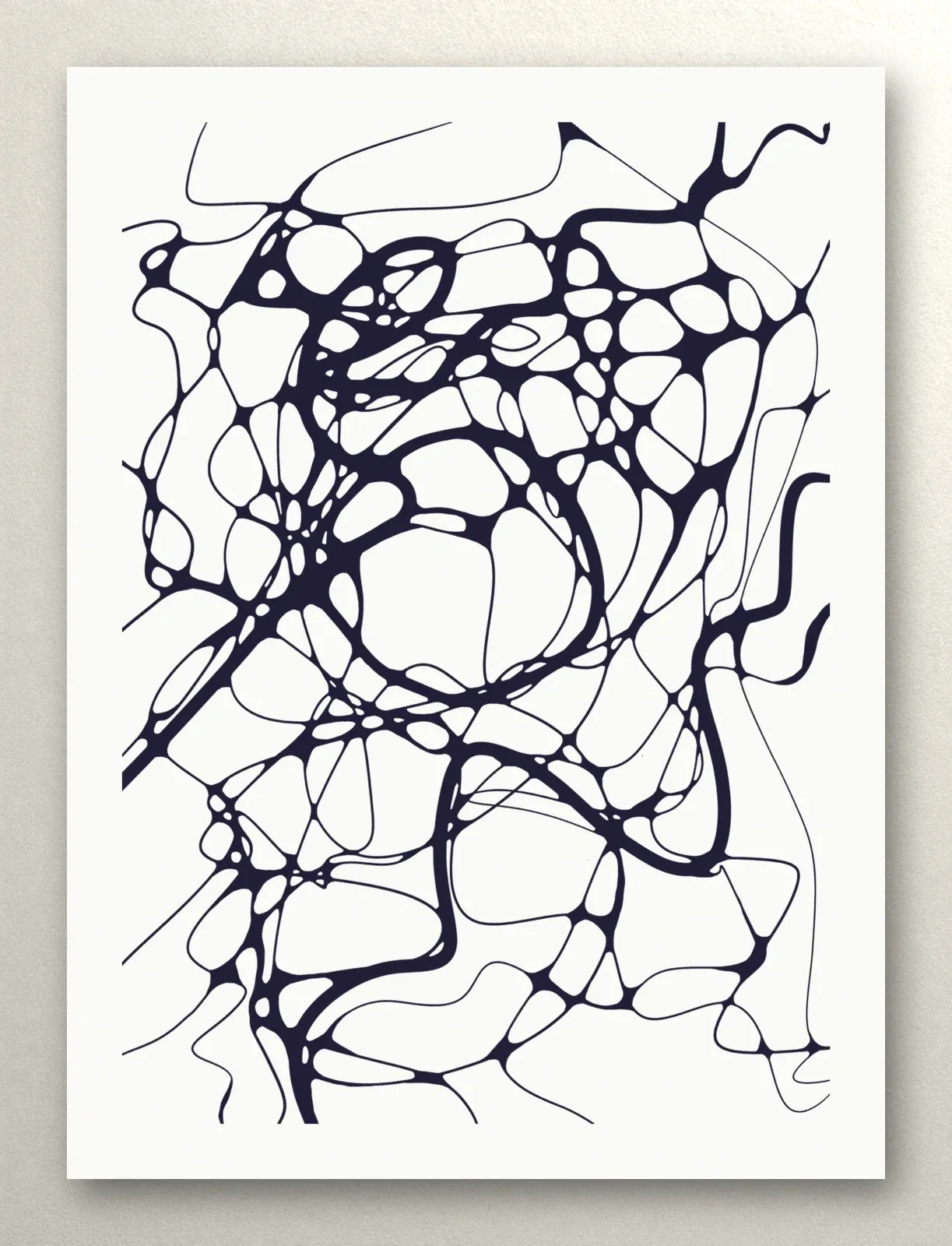
How to fill the page evenly
- Draw the first line diagonally or in a wide arc across the whole page. It claims the space right away.
- Send the second in a different direction. If the first went left to right, let the second go top to bottom or along the other diagonal.
- Put the third and the rest where it’s empty. Look at the page and route the line through the largest blank area.
- Turn the page. Upside down or sideways, it’s immediately clear which part feels heavier.
On a letter-size sheet, three to five lines usually fill the space evenly. More lines mean a denser drawing — and more rounding.
Where to leave breathing room
Breathing room means the cells left between the lines. You need them for several reasons:
- room to round. When lines run too close together, the crossings merge into a solid blot;
- room for color. Large cells are the most visible areas once you color;
- a rest for the eye. A drawing that’s equally dense everywhere reads as a gray mass.
It helps to have cells of different sizes: a few big ones, many medium ones, small ones near the crossings. An unpredictable line gives you that variety by itself — as long as it changes both its direction and the size of its curves.
Rhythm: long and short
A composition’s rhythm is born in the line. Long, smooth stretches calm the page; small turns add tension. If the whole line is made of small curves, the drawing looks fussy; if it’s all long sweeps, it looks empty. Alternate: a long run across half the page, a few short turns, then another long run.
A circle as the center
A shape in the drawing can become the point your eye rests on. One of the course’s algorithms has a dedicated step for drawing a circle to “anchor” the drawing, and suggests choosing its place and size intuitively, as you feel like it.
A few observations that help:
- the circle doesn’t have to be in the middle. Shifted toward a corner, it often looks more alive;
- a large circle takes the lead, while a small one becomes an accent among the lines;
- connect the circle to the rest of the page with lines, and round the new crossings the same way.
Portrait or landscape
The same set of lines on a portrait and a landscape page makes two different drawings. A tall page pulls the eye up and down; a wide one, along. Try both — the course has rounding templates in each orientation.
Exercise: three thumbnails
Before a full drawing, sketch three small rectangles on scrap paper, about 2½ by 3 inches. In each, draw three lines in a different way:
- all three as long arcs;
- one long line and two with small turns;
- lines that converge near one edge.
See which thumbnail you like best and carry its idea over to the big sheet. You don’t need to round the thumbnails — they’re just for composition.
What comes next
Composition is built from lines; we covered how to draw them in The First Line. After the lines comes rounding the intersections, and then, if you like, color. In the Neurojournal course, the line, shapes, and colors each get a lesson in “The alphabet” module, and the algorithms with their general lines are in the “Algorithms” module. The first module is open without an account — start there.